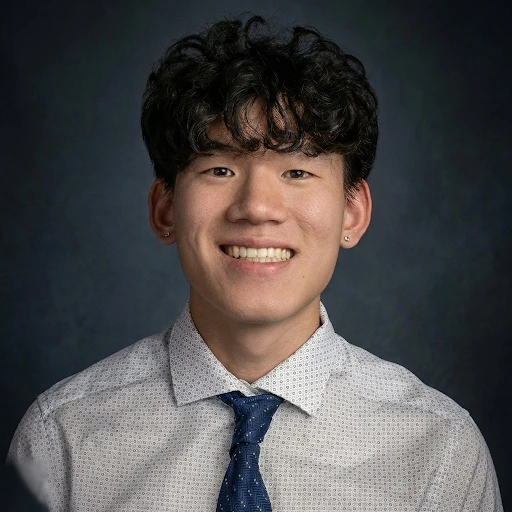
Chengdong (Peter) Zhou
Computational psychiatry: reward learning, anhedonia, and multimodal biomarkers of psychiatric state (acoustic prosody, MEG, fMRI), with a commitment to accessible and inclusive research design.
czhou732@usc.edu · Los Angeles, CA
Education
University of Southern California
B.A. Psychology
GPA 3.72 / 4.00 · Phi Beta Kappa, Epsilon of California (inducted Spring 2026, junior year, as a transfer student)
Coursework Behavioral Neuroscience, Statistics (PSYC 274L), Psychological Disorders, Experimental Research Methods (PSYC 314), Origins of the Mind, Neural Network Models (PSYC 450, in progress), Directed Research (PSYC 490X)
Arizona State University
B.A. Psychology (transferred to USC)
GPA 3.84 / 4.00 · Dean’s List, Spring 2024 – Spring 2025
Research interests
Computational psychiatry; reward learning and anhedonia; scalable voice and digital biomarkers of mood and emotion.
Honors and awards
- 2026–27
- NIH Undergraduate Scholarship Program (UGSP) Scholar
- 2026–27
- Commissioner Michael L. Williams Endowed Scholar
- 2026
- Phi Beta Kappa, Epsilon of California
- 2026
- NIH Summer Internship Program Fellow, NIMH Experimental Therapeutics & Pathophysiology Branch
- 2026
- Dornsife Experiential Learning Award
- 2024–25
- Dean’s List, Arizona State University (Spring 2024 – Spring 2025)
Research experience
Founder & Director
PRAXIS
Psychiatry Research, Analytics & eXperimental Innovation Society · Faculty sponsor: Dr. Laurent Itti
- Founded and lead an undergraduate computational neuroscience research group investigating acoustic biomarkers of depression through the dopaminergic reward system.
- Preregistered the study on the Open Science Framework (osf.io/bsvrj) and coordinated a multi-stream analysis pipeline spanning acoustic analysis, self-report, and fMRI.
- Public launch in Fall 2026 with three officers and five research members, a speaker series with researchers from USC, NIMH, Stanford, Yale, and Emory, and a biweekly journal club.
- Developed ClinicalWhisper, an open-source, on-device clinical speech analysis pipeline used across the group’s research streams.
NIH Summer Intern
NIMH Experimental Therapeutics & Pathophysiology Branch
Mentors: Dr. Mark Kvarta & Dr. Samika Kumar · Branch Chief: Dr. Carlos Zarate
- Built a Lempel-Ziv complexity pipeline for source-localized MEG data from 57 patients with major depressive disorder (MNE-Python on NIH Biowulf, SWARM-parallelized), testing broadband and six frequency bands at the right subgenual ACC and right anterior insula.
- Exploratory analyses, not corrected for multiple comparisons, linked insula broadband complexity to MADRS severity and insula delta-band complexity to a suicidal-thoughts factor. The work contributes to a planned multimodal NIMH study (manuscript in preparation; middle author).
Undergraduate Research Assistant
iLab, Visual & Computational Neuroscience
PI: Dr. Laurent Itti · Paid, part-time, NIH-funded
- Designed and deployed a fully accessible survey pipeline using Qualtrics logic flows and custom scripting, ensuring WCAG compliance and collecting 493 responses from blind and visually impaired adults (291 retained after a two-stage quality-control filter).
- First author of a review paper in preparation on vision-based assistive technology, informed by the survey, with collaborators now at Georgia Tech.
- Led a pre-registered benchmark of acoustic prosody versus ventral-striatal fMRI for anhedonia classification, resulting in a first-author bioRxiv preprint (2026).
- Coordinate and moderate IRB-approved Zoom focus groups with blind and visually impaired adults (pilot May 2026; weekly tier-based sessions in Fall 2026). Findings will inform live prototype testing of the AI assistive device.
Directed Research Fellow
Depression, Neurobiology, and Social Cognition Lab
PI: Dr. Stephen Read · PSYC 490X
- Built a Rescorla-Wagner reinforcement learning simulation with self-derived parameters (α as dopaminergic learning rate; β as inverse temperature, how strongly learned values drive choice), modelling how reward learning collapses under anhedonia.
- Developed a formal parameter framework mapping circuit-level variables (LHb-VTA pathway) to RL parameters and their behavioural predictions, and simulated circuit-level treatment effects (ketamine, pramipexole, rTMS, psilocybin).
- Synthesised literature on the LHb-VTA pathway and mTOR signalling to support hypothesis generation for studies on rapid-acting antidepressants such as ketamine.
Manuscripts and presentations
- Zhou, C., Wu, M., Xiang, Y., & Itti, L. (2026). Cross-Modal Benchmarking of Acoustic Prosody and Ventral Striatal BOLD for Depression-Related Anhedonia Classification: A Pre-Registered Study with the ClinicalWhisper Pipeline. bioRxiv preprint, not peer reviewed. https://doi.org/10.64898/2026.06.08.728970
- Zhou, C., et al. (In preparation). Vision-based assistive devices: A review informed by a survey of blind and visually impaired users [working title]. Manuscript in preparation, first author.
- Zhou, C., Wu, M., Xiang, Y., & Itti, L. (Jul 2026). Cross-Modal Benchmarking of Acoustic Prosody and Ventral Striatal BOLD for Depression-Related Anhedonia Classification. Poster, Computational Psychiatry Conference, Yale University.
- Zhou, C., Kumar, S., Gilbert, J., Zarate, C., Jr., Ballard, E., & Kvarta, M. (Aug 2026). Characterizing suicidality using band-specific resting-state MEG neural complexity. Poster, NIH Summer Poster Day, Bethesda, MD.
- Zhou, C. (Apr 2026). The dopaminergic voice: Acoustic prosody vs. ventral striatal BOLD activation for anhedonia classification. Poster, 27th USC Undergraduate Symposium.
- Zhou, C. (Nov 2025). Attentive AI visual aid for persons with visual impairment. Poster, Trojan Research Association Undergraduate Research Symposium.
Teaching
Curriculum designer and journal-club lead
PRAXIS, Computational Psychiatry
Computational Psychiatry: An Undergraduate Syllabus · CC BY 4.0 · doi 10.5281/zenodo.20559875
- Designed a twenty-paper, five-module curriculum taking undergraduates from the founding papers of computational psychiatry through reinforcement learning, Bayesian models of psychosis, and biomarker methodology to algorithmic bias in clinical prediction.
- Adopted as the PRAXIS journal-club curriculum for Fall 2026, running as nine sessions across the semester.
- Published open access under CC BY 4.0 with a Zenodo DOI. Every reading is linked to its publisher record and exportable as BibTeX taken from that record rather than typed by hand.
- Released bilingually in English and Simplified Chinese to lower the entry cost for students reading the literature in a second language.
Skills
- Programming
- Python (scikit-learn, pandas, NumPy), Bash/Shell, Git/GitHub, LaTeX/Overleaf
- Modelling
- Reinforcement-learning simulation (Rescorla-Wagner), classification (logistic regression, random forest, gradient-boosted trees), cross-validation and permutation testing
- Speech & audio
- Acoustic feature extraction (OpenSMILE eGeMAPS), on-device transcription and diarization (ClinicalWhisper)
- Neuroimaging
- MEG signal-complexity analysis (virtual electrodes, band-pass/Hilbert envelope, Lempel-Ziv complexity)
- LLMs & HPC
- Local LLM inference (Ollama, MLX); NIH Biowulf, Slurm
- Statistics & tools
- SPSS (GLM, ANOVA, regression), Qualtrics (scaled deployment), OSF (pre-registration), iSTAR (IRB); CITI certified in human subjects research and Responsible Conduct of Research
- Languages
- English (native/fluent), Mandarin (native), Spanish (intermediate)
Clinical and service
Crisis Counselor
Crisis Text Line
- Supported 200+ texters in crisis over 200+ volunteer hours via SMS; typically 2 concurrent conversations and about 5 texters per shift.
High-Impact Academic Tutor
Step Up Tutoring
- Delivered weekly one-on-one tutoring to underserved students; designed personalized, data-informed lesson plans to boost reading and math comprehension.
Registered Behavior Technician
Kyo
- Implemented ABA interventions (DTT/NET) for children with autism spectrum disorder; tracked behavioral data and documented goal mastery.
Summer Camp Counselor
The H.E.A.R.T. Center
- Facilitated social-emotional learning for 30+ neurodivergent children; managed behavioral de-escalation.